
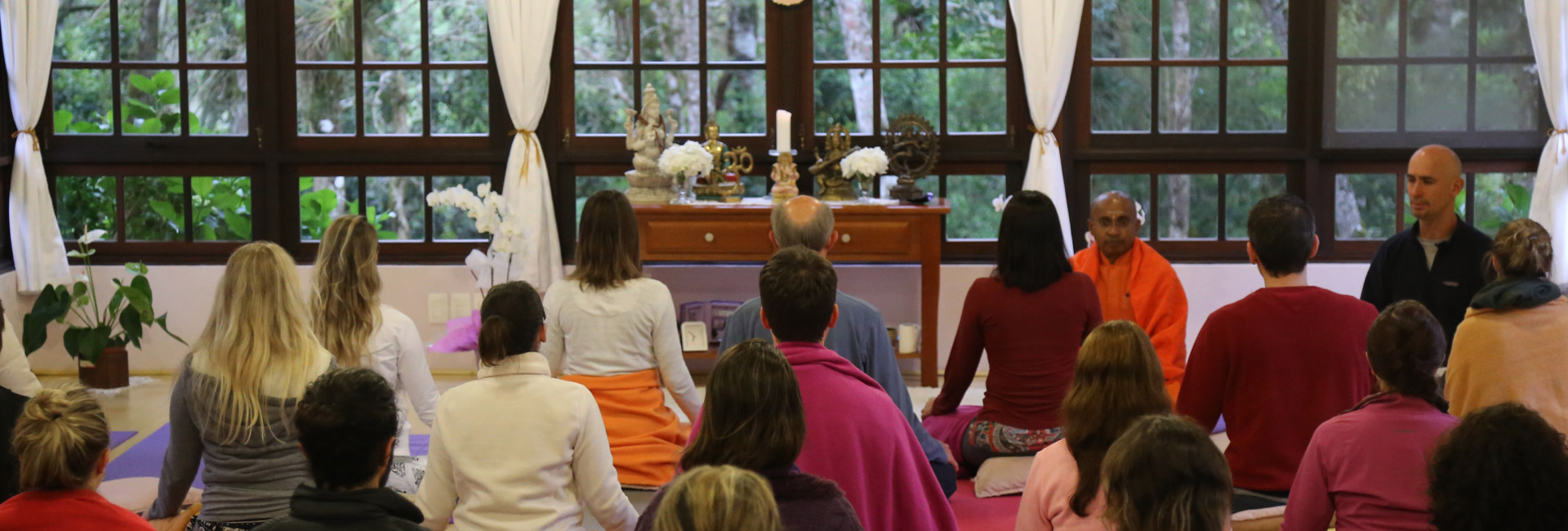
Yoga Nidra is a practice which can be widely applied in the modern world to improve the quality and happiness of human life.
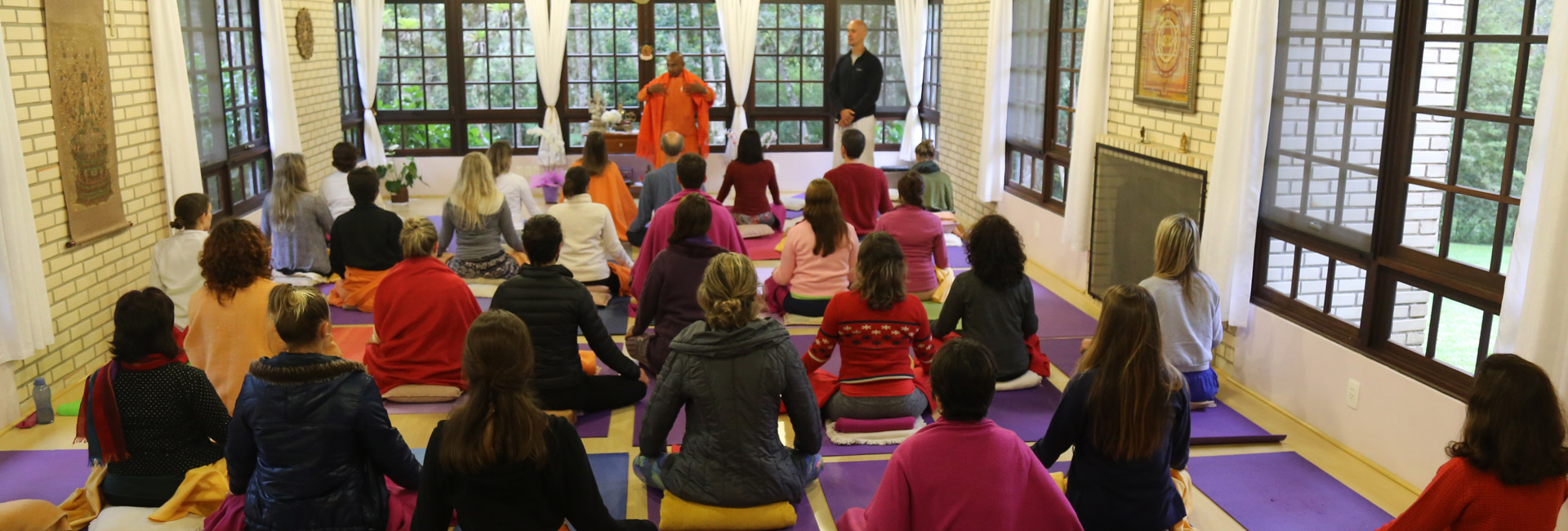
Yoga Nidra can be defined as a state of conscious deep sleep. It is both the name of a specific practice and a state of being.
Yoga Nidra is a state of mind in between wakefulness and dream. Normally when we sleep, we loose track of our self and cannot utilize this capacity of mind. Yoga Nidra enables the person to be conscious in this state and nurture the seed of great will power, inspire the higher self, and enjoy the vitality of life.
Yoga Nidra restructures and transforms our whole personality form within. With every session of yoga nidra we are actually burning our old Samskaras, habits and tendencies in order to be born anew.
In Yoga Nidra, sowing of seeds of change is found in Sankalpa, which you make for yourself during each practice. Sankalpa can be translated as resolve or resolution. It is the most powerful method for reshaping your personality.
It is only possible to stay at Ashram if you are taking one of our residential courses/retreats or are an established Buddhist practitioner doing your own formal Buddhist retreat of a minimum of 10 days duration.
Since Ashram is a semi-monastic meditation centre and not a guesthouse, we ask all of our retreatants and visitors to observe the following rules of discipline in order to maintain an atmosphere conducive to inner reflection and meditation:
Respect all life: do not intentionally kill any living being, even small insects.
Respect others’ property: do not steal or take anything not freely given.
Be honest and straightforward: do not lie or intentionally deceive others. This is easy when observing silence!
Be celibate: no sexual activity. This also includes no holding hands, hugging, massages and other physical displays of affection.
Be alert and mindful: avoid intoxicants such as alcohol, drugs and cigarettes (we encourage you to stop smoking while here, but if this is impossible, one can smoke at a designated place within the centre boundary).
Be considerate of others’ silence: keep silence in the appropriate areas and at all times during residential courses, especially in the Gompa and the dormitories. No singing or playing music and in general, maintain a quiet demeanor while on the property.
Be considerate of the monks and nuns: dress respectfully (please no shorts above the knee, tank-top shirts or tight and revealing clothing).
In order to keep the atmosphere conducive to inner reflection and spiritual pursuit and to minimise distractions during the course, students on our residential courses and retreats are asked to abide by our basic code of discipline listed below.
Please settle all outside communication before the course begins. Telling friends and family that you will be out of contact for the duration of the course and sticking by that decision significantly reduces distraction from investigation into the workings of your own mind! Likewise, please settle your travel arrangements etc before you come to here!
You are expected to observe silence (no talking at all) from the evening of the first day until the end of the course.
Do not leave here for the entire course.
Participants must attend all sessions of the course and come to sessions on time.
Please put all communication / entertainment devices (laptop / mobile phones /cameras / MP3/CD players) etc into our safe at check-in.
Please be gentle in your behaviour and sensitive to fellow group members.
“Gompa” is a Tibetan word which we use for Meditation Hall. Because a Gompa is the location of study, meditation and devotional practices, Buddhists consider them to be holy places. In this tradition, the following modes of behaviour are considered respectful in a Gompa and we ask you to follow them while here:
Do not point your feet towards the teachers, the altar or any holy object.
Do not put Dharma materials – prayer books, texts, Dharma books or notebooks with Dharma in them – on the floor, or sit or step over them.
Do not lie down or do any yoga exercises in the Gompa at any time.
No idle chit-chat in the Gompa (ie. You can ask the teacher questions during class, but do not talk with other students).
| Time | Schedule |
|---|---|
| 1:00pm | Check-in |
| 2:30pm | Welcome and Introduction Talk |
| 3:30 – 4:30pm | Teaching Session 1 |
| 5:00 – 6:00pm | Teaching Session 2 |
| 6pm | Dinner |
| 7:30 – 8:15pm | Guided Meditation |
| Time | Schedule |
|---|---|
| 6:45 – 7:30 am | Guided Meditation |
| 7:30am | Breakfast |
| 9:00 – 10:00am | Teaching Session 1 |
| 10:00 – 10:30am | Break |
| 10:30 – 11:45am | Teaching Session 2 |
| 11:45am | Lunch |
| 2:00 – 3:00pm | Teaching Session 3 |
| 3:00 – 3:30pm | Tea Break |
| 3:30 – 4:45pm | Teaching Session 4 |
| 4:45 – 5:15pm | Break |
| 5:15 – 6:00pm | Guided Meditation |
| 6:00pm | Dinner |
| 7:30 – 8:15pm | Guided Meditation |
| Time | Schedule |
|---|---|
| 6:45 – 7:30am | Guided Meditation |
| 7:30am | Breakfast |
| 9:00 – 9:45am | What comes next ? Talk |
| 10:00 am | Advice for further study/practice and Feedback session |
| 12:00 – 1:00pm | Picnic Lunch |
| 1:00 – 3:00pm | Check-Out |
When you enter India, you’ll find a lot of people claiming they are gurus or masters. But most of them are just teachers...
Read More
Munich, Germany
There are many teachers and yogis who have lots of knowledge and experience, but few teachers embody the unconditional love...
Read More
Hood River, Oregon USA
SWAMI OMKARANANDA é um excelente professor… Eu aprendi muito com ele… neste Retiro em Rishikesh – INDIA...
Read More
Brazil
I feel very blessed to have met Swami Omkarananda and honored to have had the opportunity to learn from him...
Read More
Hood River, Oregon, USA
Swami Omkaranada provided me with the proper tools and guidance in order for me to discover my spiritual path...
Read More
New York, USA